Commit
Choose under uncertainty
State an assumption and make a decision before every fact is available.
 Competitive
Competitive Strategy · Graduate marketing
Competitive Studio
An integrated decision-making lab built around consequential practice and structured reflection.
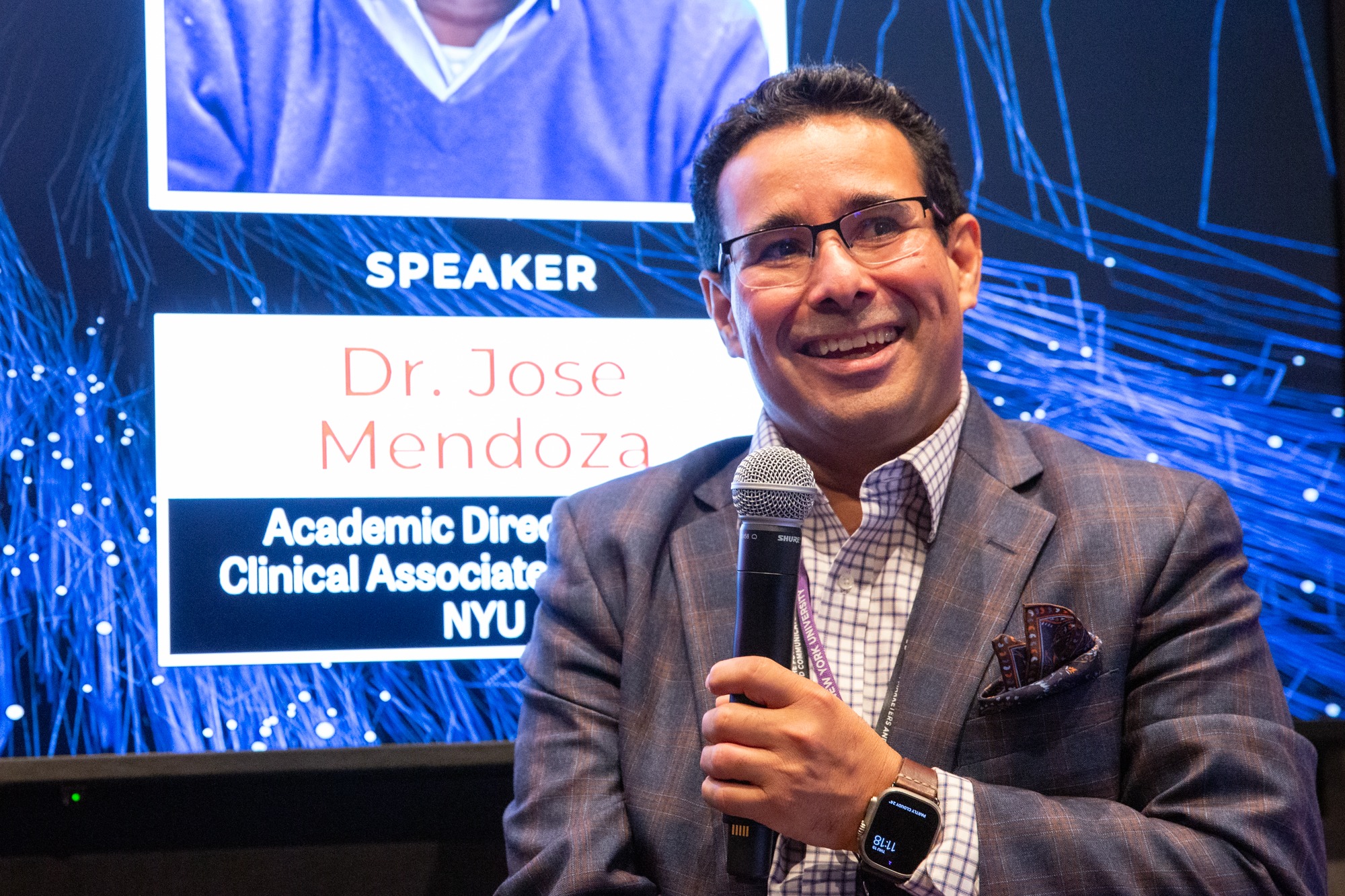
Clinical Associate Professor
Academic Director, MS in Integrated Marketing
NYU School of Professional Studies
01 / The learning problem
Students need practice applying strategic frameworks when information is incomplete and other people react to their choices.
Commit
State an assumption and make a decision before every fact is available.
Respond
Adapt when competitors or counterparties change the conditions.
Reconsider
Trace the outcome to the reasoning, then explain what should change.
Give students repeated opportunities to turn conceptual understanding into defensible strategic judgment.
Source: Mendoza, Teaching Competition Paper, “The Problem.” This is the instructional need addressed by the lab.
02 / The teaching innovation
Brief the concept and make the strategic objective explicit.
What are we trying to achieve?Commit under time pressure, incomplete information, and competing interests.
What will we do, and why?Inspect the result and the responses of competitors or counterparties.
What happened?Connect the experience to theory and revise the next decision.
Which assumption needs to change?Purpose-built activities share a decision and debrief structure. Students carry earlier reasoning into a culminating recommendation and defend it through peer critique.
Source: Mendoza, Teaching Competition Paper, “The Innovation.”
03 / Experience the method
You lead an airline on the JFK–Boston corridor. Your team must respond before the next round.
Choose a response. Be ready to explain your assumption.
Discussion prompt adapted from the airline activity. The choices do not run the live simulation.
04 / Consequences and debrief
Final profit, USD millions · Spring 2026 classroom run
Classroom simulation results; not student learning scores.
Airline E reported $8.74M in total costs; Airline A reported $11.63M. The debrief connects pricing, capacity, product, and brand decisions to the cost structure.
Which assumption needs revision? What would you examine before the next decision?
Source: Airline Simulation Final Assessment, pp. 1–2. Reported figures are rounded. These results illustrate one classroom run, not the outcome of the preceding audience choice.
05 / Learning across sessions
Students carry competitive and economic reasoning into a recommendation supported by scenario analysis and AHP, then defend it through peer critique.
Learning progression: competition paper. Connections are instructional; they do not imply automatic data transfer between applications. Select a row for activity details and links.
06 / Synthesis in the culminating pitch
Vela has $12 million to invest. Choose one option, or split the budget across two.
Vela Skincare is a classroom case. The budget and options are case assumptions.
Choose the uncertainties; compare robustness and fragility.
Make pairwise comparisons; inspect consistency and sensitivity.
The pitch brings the analyses together. Teams justify the investment and respond to peers’ challenges to their assumptions.
Sources: Strategic Decision Lab; AHP Studio User Guide.
07 / AI supports the method
Faculty + AI
GitHub Copilot supported the development of purpose-built tools for the course.
Faculty define the learning objective, inspect the behavior, and shape the debrief.
Student + AI
Student responsibility
AHP calculations and scenario robustness measures use defined computations. AI supports interpretation and practice; the negotiation tool also uses AI in some evaluation modes, so its feedback calls for review.
Sources: author’s development account; AHP Studio, Scenario Manager, and Negotiation Sim documentation.
08 / Assessment and debrief
One AHP reflection describes revising weights until the ranking matched the team’s initial preference.
Did the team improve its judgments, or tune the model to its preferred answer?
Ask students to justify each revision, compare the sensitivity results, and explain what evidence would change their recommendation.
This is a debrief opportunity, not a finding of misconduct. Formal evaluation of learning gains remains in progress.
Sources: Airline Simulation Final Assessment, p. 5; anonymized reflection DL22. Debrief questions are proposed for this presentation.
09 / Student-reported learning
Selected anonymized excerpts from the submitted reflections. Qualitative examples of student-reported learning, not measured learning gains or a frequency estimate. Earlier percentages based on 53 reflections are excluded.
10 / The faculty takeaway
MIT verified in five repositories. The supplied Dynamic Pricing repository could not be verified in this review.
Repository licenses reviewed September 11, 2026. Linked licenses govern code reuse. Course materials and NYU marks retain their own rights.
11 / Your next teaching decision
Begin with a decision they understand in theory. Give them a chance to make it, examine the consequences, and explain their next choice.
Explore the Decision Lab ↗mma.jose-mendoza.com · presentation
NYU School of Professional Studies
Google Higher Ed Faculty AI Fellow

Scan for the public project hub.
MMA Teaching Innovation Competition · September 24, 2026 · New Orleans