Flexibility
Fit the teaching sequence
I needed activities I could use independently and fit to the pace and objectives of each session.
 Competitive
for Experiential Learning in
Marketing Strategy Courses
Dr. Jose Mendoza
mma.jose-mendoza.com
01 / Background
Academic Director, MS in Integrated Marketing
Google Higher Ed Faculty AI Fellow
How can AI support teaching and learning across a program of this size?
02 / The learning problem and design constraints
Students need repeated practice making decisions, seeing consequences, and revising their reasoning under uncertainty.
Why I built custom tools: commercial simulations posed three challenges for my course.
Flexibility
I needed activities I could use independently and fit to the pace and objectives of each session.
Adaptability
I wanted greater control over cases, decision rules, feedback, and the role of AI in learning.
Cost
Commercial licensing costs were a barrier to access and to using tools across courses.
Build modular tools around course objectives, with adaptable activities, AI learning support, and open resources for faculty.
03 / The teaching innovation
Independent browser tools connect practice across the course through a shared learning sequence.
AI is part of the learning design. Embedded AI learning coaches support feedback and interpretation; an AI counterpart supports negotiation practice.
04 / A custom case study
An original teaching case, like PITH, built around a strategic investment decision.
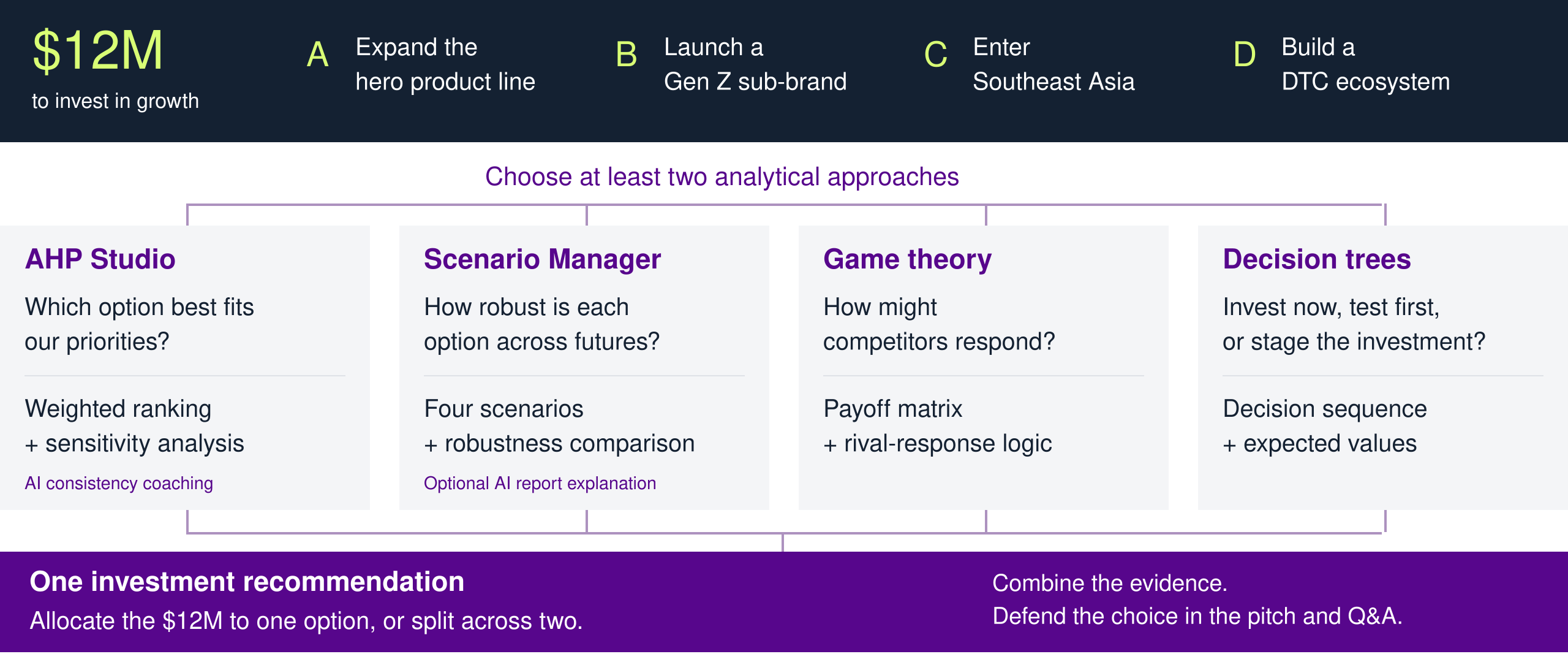
05 / AI’s role in the teaching design
Faculty + AI
GitHub Copilot supported the development of purpose-built course tools.
Faculty define the objectives, inspect the activity, and design the assessment and debrief.
Student + AI
Student + AI
An AI counterpart responds to proposals in a brand partnership negotiation.
AI feedback helps students examine their approach against the negotiation rubric.
Students compare AI explanations with results and justify revisions. AHP and scenario calculations follow defined methods; faculty and students review AI interpretations and evaluations.
06 / Assessment and debrief
Across activities, students explain assumptions, interpret consequences, and justify revisions—including how they use or challenge AI feedback.
Does the revision improve the judgment, or simply produce a preferred answer?
Ask students to justify each revision, compare the sensitivity results, and explain what evidence would change their recommendation.
07 / Student-reported learning
08 / The faculty takeaway
09 / Beyond the original course
Tools now serve other courses, including the Pricing Sandbox.
Separate applications made it easier to adopt individual activities.
Evolved from the toolset and already used in two courses.
The PITH brand exercise applies the design principles. A presentation is forthcoming at NYU’s Faculty Success Initiative.
Design principles accommodate faculty with different technical skill levels.
Planned for teaching in Spring 2028.

Project hub